
Charlie Hyman’s ‘Flat Earth’ Brings Surreal Ceramics to Ivester Contemporary
The UT Austin alum’s first exhibition with the gallery transforms ornate clay vessels into vivid scenes
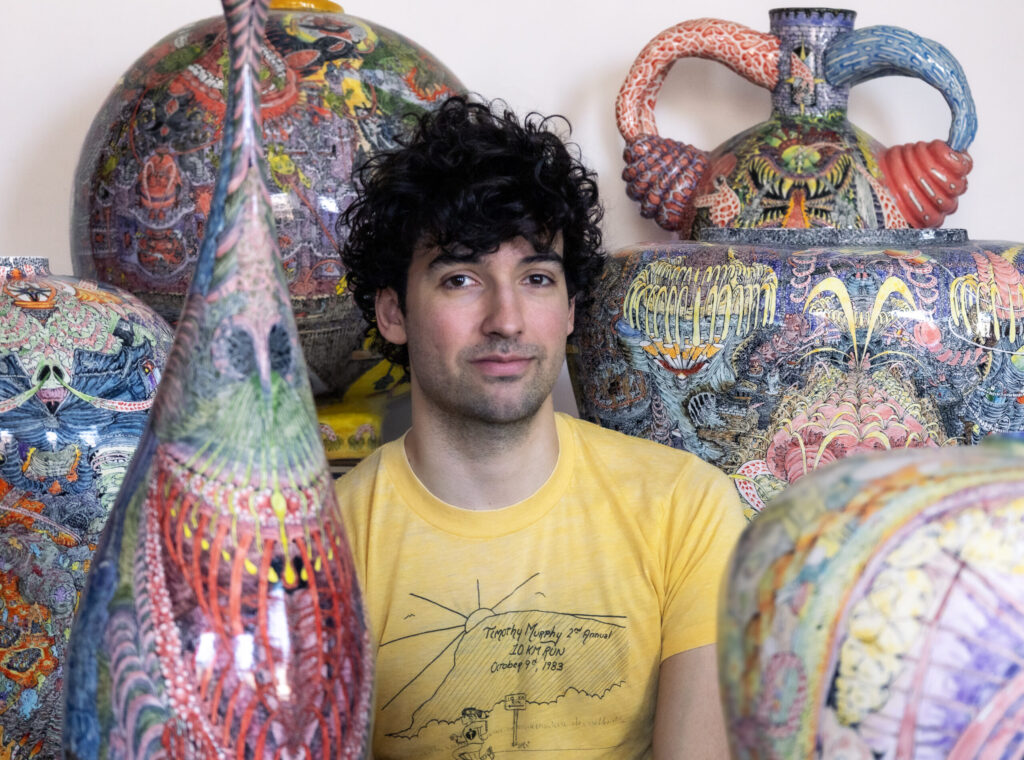
The solo exhibition, Charlie Hyman’s first at Ivester Contemporary, invites viewers into a surreal realm of sycophantic toads, fleshless mouths and hedonistic rats, all hand-painted onto a series of ornately designed clay vessels. While the exhibition title, “Flat Earth,” brings to mind the notable conspiracy theory in which the earth is not actually round, Hyman is more interested in the “conspiratorial thinking” that frequently accompanies early adulthood — a grand “disillusionment” with the systems that govern day-to-day life.
“My work is in a lot of ways about entering a new era … without the structures of family or school,” he said during an artist talk on April 25 hosted at Ivester Contemporary. The conversation was facilitated by Annie May Johnston, one of Hyman’s former professors in the Studio Art program at The University of Texas at Austin. “You have to form your own thinking about the systems you’re a part of,” he continued.

Naming ‘Flat Earth’
Though Hyman’s exhibition title is tongue-in-cheek, “Flat Earth” also captures his sense of “being beholden” to broader networks of power and “existing as a young person in the world” within them, he said.
SHOP


“Growing up in the South, I created a lot of narratives about what existed beyond me,” Hyman said. After moving to New York, he discovered that a person “can’t really escape the self.”
With “Flat Earth,” he navigates that tension with vibrancy and humor, even artfully weaving vapes and a Labubu into one vessel’s gloriously unruly panorama.
“(The vessels) are already this really precious thing,” Hyman said. “And I try to make art in a non-precious way.”

Form contrasts content
Large decorative ceramics are historically regarded as elite objects, well-suited for luxury homes or classical museum galleries. Hyman’s lavish creations, however, contrast form with content.
From a distance, “Flat Earth” appears like a lush interpretation of the Hanging Gardens of Babylon, but up close, Hyman’s ceramics betray a world ruled by tyranny, labor and indulgence. Serpentine tongues twist, vine-like, through abject scenes of disorder.
“I was also playing on biblical stories,” Hyman said. “Like an apocalypse narrative of what is left over when there’s no longer a focus on goodness.”
Despite his evocation of derelict chaos, Hyman infused a tremendous amount of symmetry into the pieces. During the creation process, he painstakingly orbited the structures while painting them, etching intricate details into his strange ecosystem at odd angles.
“I do try to make these math games of perfect order and symmetry (in my work),” Hyman said. “I operate from this place of more is more is more.”
That labyrinthine excess mirrors the real-life systems “Flat Earth” explores. The effect is existential: How does society spin meaning from what lies beyond mortal comprehension?

Refusing linear narrative
As one audience member at Hyman’s artist talk pointed out, “Flat Earth” recalls “The Garden of Earthly Delights,” a famed triptych that uses complex biblical imagery to warn against temptation. While many art historians view Hieronymus Bosch’s work as earnest, Hyman’s version opts for irreverence. Instead of proselytizing, he encourages viewers to linger in “Flat Earth’s” visual riot and, perhaps, relinquish their own subjectivity.
Hyman was also inspired by medieval iconography and Greek sculpture. In both traditions, artists translated their daily lives onto objects of grandeur, whether testifying to plague-induced horrors or reliving spirited bacchanalia.
“The guiding thing is that I want to be able to see everything all at once, at all times,” Hyman said. With his vessels, “every single detail and every single move are all in the same nonlinear sort of timeline.”
In addition to Studio Art, Hyman studied Radio-Television-Film at The University of Texas at Austin. “Flat Earth” builds on that training by exposing the limits of linear storytelling.

Daily vessels
Rather than presenting a neat narrative arc, Hyman’s ceramics collapse the idea of beginning, middle and end. The stories bend around one another, rejecting stasis and provoking viewers to read the objects with flexible curiosity rather than the goal of masterful understanding.
Even as the characters of “Flat Earth” seek salvation, Hyman reminds viewers that, at the end of the day, “you’re still left with your physical, tattered body” — life’s ultimate earthly vessel.
In the end, there is one thing shared by all: Despite desires otherwise, people can only truly mold the vessels in their hands.
“Flat Earth” runs through May 16 at Ivester Contemporary. The gallery also co-organizes and will participate in Austin’s upcoming Friends Fair at The Loren Hotel Austin.