
Bullock Museum Turns 25: The Story Behind Texas’ History Hub in Austin
Director Margaret Koch looks back on the moments, milestones and artifacts that shaped the museum’s first quarter century
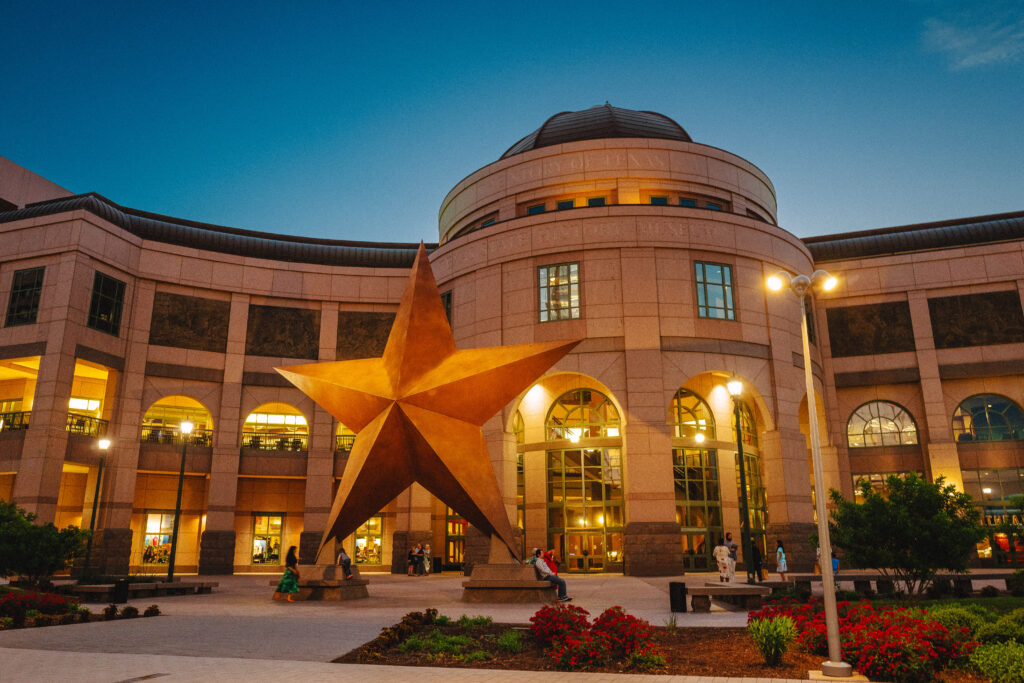
As the Bullock Texas State History Museum approaches its 25th anniversary in April, Director Margaret Koch reflects on the very start of the cultural institution’s journey — one that began with Bob Bullock, Texas’ lieutenant governor from 1991 to 1999. Traveling across the country in his political life, Bullock saw the power of museums to educate, inspire and unite communities. He envisioned a museum for Texas as a space that would encompass every region of the state, and serve as a beacon for students and families alike. “Education was very close to his heart,” notes Koch, “and he really wanted students to connect with Texas history.”
In 1996, the discovery of the shipwrecked La Belle gave Bullock’s vision for a state museum a tangible anchor. The 17th-century French ship was wrecked in a storm in 1686 and sank to the bottom of Matagorda Bay, where it sat for over 300 years. When archaeologists discovered the site in the mid-1990s, a decades-long effort began to excavate, recover and preserve the ship’s hull, along with over 1.6 million artifacts. As Koch tells the story, Bullock then declared, “That ship is going to need a home,” which fast-tracked the museum from concept to reality. Koch adds, “So the architecture of the building and everything about the space was all designed and inspired by the finding of La Belle.”

The Bullock’s origin story
By 2001, the Bullock Texas State History Museum doors opened, and Austin had a new landmark where history could be explored and experienced firsthand.
SHOP


Of course, La Belle’s excavation process was prolonged and laborious, so the museum didn’t welcome this grand exhibit until far after the museum opened. Work began around 2014, when the ship’s timbers started arriving in Austin. The vessel was originally intended for the main long-term gallery for which it was designed, but the unexpected cancellation of a traveling exhibition left another gallery empty. Rather than leave the space unused, staff chose to assemble the ship there, allowing visitors to witness the process as it unfolded. Assembling La Belle became an exhibit in itself, until it finally took its placement within the main gallery of the museum in 2018.
While La Belle remains central to the museum’s story, it actually remains under French ownership. A 99 year international treaty assigns stewardship to the Texas Historical Commission and caretaking responsibility to the museum. Koch emphasizes that arrangements like this underscore the museum’s core strength: its relationships with lenders who entrust their treasures, with donors who make exhibitions possible and with visitors who bring the museum to life. Because many artifacts are on loan, the museum’s galleries are constantly evolving.

Artifacts with stories to tell
Beyond La Belle, the Bullock Museum houses several notable artifacts. Koch mentions her fondness for the 1941 AT-6A “Texan” airplane because, to her, it honors the Women Airforce Service Pilots, whose contributions went largely unrecognized for decades. She is also particularly drawn to a historic mission gate from the San Antonio area. The two halves of the gate doors were separated for more than a century before being reunited and undergoing extensive conservation work. To her, the gate embodies the human experiences of the missions as gathering places and centers of community life.
“When the doors were displayed together, it was incredibly powerful,” Koch recalls. “If you’re just looking at a piece of old worn wood, a very human story might not come to you. But yet, each of those pieces has this amazing emotional attachment.” For Koch, a museum is a place where every nuance can be researched, revealed and reflected upon.
The museum itself is a hands-on experience. Renovations in 2018 introduced new technology, digital interactives and films that allow visitors to experience history like a detective. Koch says, “A good exhibit will draw you in bit by bit, and you can interpret what you see, what you read and how you process it. Our goal is not to tell you what to think or even how to think. It’s just to impose information that’s going to give you questions that you want to delve deeper into.”

Signature programs
Community engagement is also central to the museum. Signature programs include Music Under the Star, a free summer concert series, as well as H-E-B Free First Sundays, with activities geared towards children and bringing generations together. Each of these initiatives embodies the museum’s belief that history is not a distant story — it is a shared experience.
Looking ahead, Koch sees the next 25 years as an opportunity to deepen these connections with upcoming exhibits and programming. The museum is also strengthening resources for teachers and expanding distance learning, ensuring that the lessons of history reach students far beyond Austin.
For those who have yet to step inside the Bullock Museum, Koch offers a simple invitation: “Whatever you’re interested in, we really hope that you’ll find something here that resonates with you.” Koch says, “I want everyone to see us as a go-to place for Texas History 101 and to feel like you belong here, even if you’re not from Texas.” In this way, the museum fulfills Bob Bullock’s vision of not only preserving artifacts, but cultivating a space where every visitor can feel the heartbeat of Texas history.
RELATED: The Best Museums in Austin