
Inside Austin Farm Sanctuary, the Nonprofit Giving Rescued Animals a Forever Home
What began with two goats has grown into a 95-acre sanctuary near Austin that now cares for more than 250 rescued farm animals
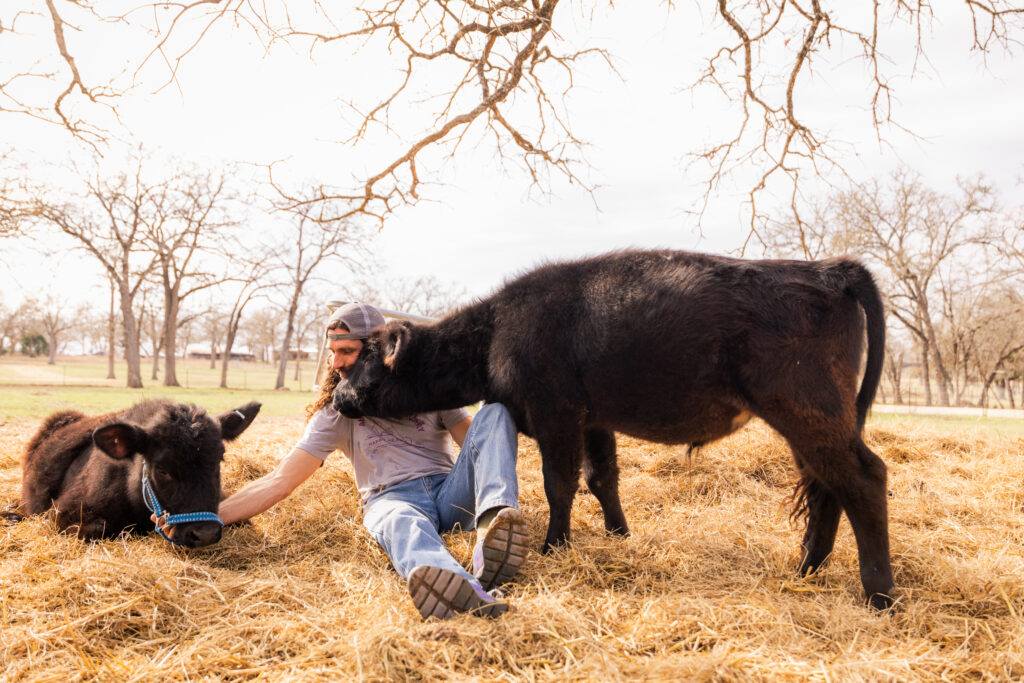
The road to Austin Farm Sanctuary opens into a wide pasture — 95 acres where goats frolic in small groups, pigs wallow in the mud and cows graze at an unhurried pace. At first glance, it might appear to be a fairly traditional farm in Paige, Texas, but the 250 animal residents are anything but ordinary. At Austin Farm Sanctuary, animals live not as commodities or categories, but as individuals — known by name, by story, by temperament.
The sanctuary began in 2016 with two goats in need. Cookie had been injured during childbirth; her daughter, Bertha, was undersized and not considered profitable for dairy production.
“They were no longer of use to the goat dairy. And luckily, that didn’t mean that they got killed, which typically is what happens,” says co-founder Chris Fuller-Wigg. He and his wife, Angela, brought them home to a half-acre property in South Austin. There was no blueprint for a sanctuary then — just a willingness to say “yes” to caring for these animals.
SHOP


The rescue that changed everything
The following year, another “yes” altered their trajectory entirely.
In 2017, Fuller-Wigg received a call about a pig named Doya. The six-month-old had been raised through a local FFA program at Bowie High School and was nearing the end of the program, which meant slaughter. The student who had cared for him didn’t want that outcome and began searching for alternatives. Through a chain of teachers and neighbors, the call landed with Fuller-Wigg.
At that point, farm animal rescue wasn’t a planned future. It was just a growing passion for the couple.
“We had both made the switch from being vegetarian to vegan. So we had this mindfulness of pigs,” Fuller-Wigg says, noting that at the time they had no experience taking care of them. “But we said yes to Doya,” he continues. “We picked him up a couple days later, and that’s really when everything changed. We were learning to connect with this different animal. He was 180 pounds, 6 months old, but just as curious and lovable, with big, floppy ears, and all the things you experience and look at on a dog or a cat. I was having this awakening with him.”
For Fuller-Wigg, Doya stirred new questions, “I thought two things,” he says. “How many more Doyas are there in the world that need to be loved on and rescued, and how many animal-loving people exist that are just waiting to help in a kind manner?” Doya eventually grew to roughly 650 pounds, a massive adult whose presence could feel imposing at first glance. “You see this kind of big, intimidating beast. But the moment you touched his ribs, he’d get down on all fours and roll for a belly rub. He helped a lot of people to see the vulnerability — the desire for love, for kindness, for a gentle touch. These animals also desire and deserve love.”

Doya’s lasting legacy
Doya became the lens through which Fuller-Wigg began to see farm animals differently, and growth soon followed. While Doya passed away in 2025, his legacy lives on at the sanctuary that is now home to goats, pigs, cows, turkeys, donkeys, longhorns and even water buffalo — many of them elderly, blind or surrendered because they no longer held economic value. Hundreds of chickens and roosters at the sanctuary were rescued from abuse, including religious mass sacrifice and the cock fighting industry.
Some animals are born with ailments; Some became sick and lost sight; Some age out of usefulness, but at Austin Farm Sanctuary, aging is not a liability.
Caring for that many lives requires structure as much as compassion. The sanctuary, a 501(c)(3) nonprofit, now employs five animal care staff members focused on feeding and medical care, alongside 30 to 40 active volunteers who show up at least twice weekly.
The operational demands are constant. “Every four days, on average, for the last six weeks this year, somebody’s at the hospital,” says Fuller-Wigg. With medical transport, specialized diets and mobility support for aging animals, the work requires donations to keep the sanctuary running.

Lives met with dignity
But beneath the logistics and fundraising, the animals are what shaped this nonprofit organization the most.
Buddy, a blind goat who arrived at 4 weeks old, required bottle feedings and close attention to navigate the pasture.
“He slept in my lap while I would work. I’d give him his bottles,” says Fuller-Wigg. “We had that deeper level of connection.”
And then there was Wendell, a calf rescued at 5 days old, critically ill and neurologically compromised. He was syringe-fed and given daily injections in an attempt to stabilize him. While Wendell did not survive, his story reflects the idea that the meaning of caregiving isn’t determined solely by whether an animal lives or dies, but by the com-passion, effort and commitment given to them regardless of the outcome.
Instead, meaning came from dignity — from ensuring that even brief lives were met with care. Wendell’s case informed veterinary protocols. Months later, when another sick calf named Zoe arrived, doctors told the sanctuary that they learned so much from Wendell that informed the treatments that ended up saving Zoe’s life.

A forever home
For staff member Ella Jo Hemza, the sanctuary feels like alignment. “I always knew that I wanted to work with animals,” says Hemza. She began as a volunteer after finding the sanctuary online. “It was serendipitous. It’s just my absolute dream job.”
Hemza recalls one afternoon early in her time there, when she looked across the pasture and felt emotional about the sanctuary’s work. “I just saw a goat leaping, and a pig running and then another cow running across the field, and I was just (thinking) ‘this is it. This is happiness. It is the happiest home for them. It’s not temporary. It is forever for them.”
That is what sanctuary means here: a home where each animal is celebrated for their individuality.
For Fuller-Wigg, it all still comes back to Doya — the pig who rolled over for a belly rub and changed the scale of what was possible.
RELATED: How Austin’s Tiny Farmer’s Market Is Bringing Neighbors Together