
Austin’s Mexican American Cultural Center Reopens After $25 Million Expansion Project
The arts-focused space features 19,000 square feet of new construction and 9,000 in renovation
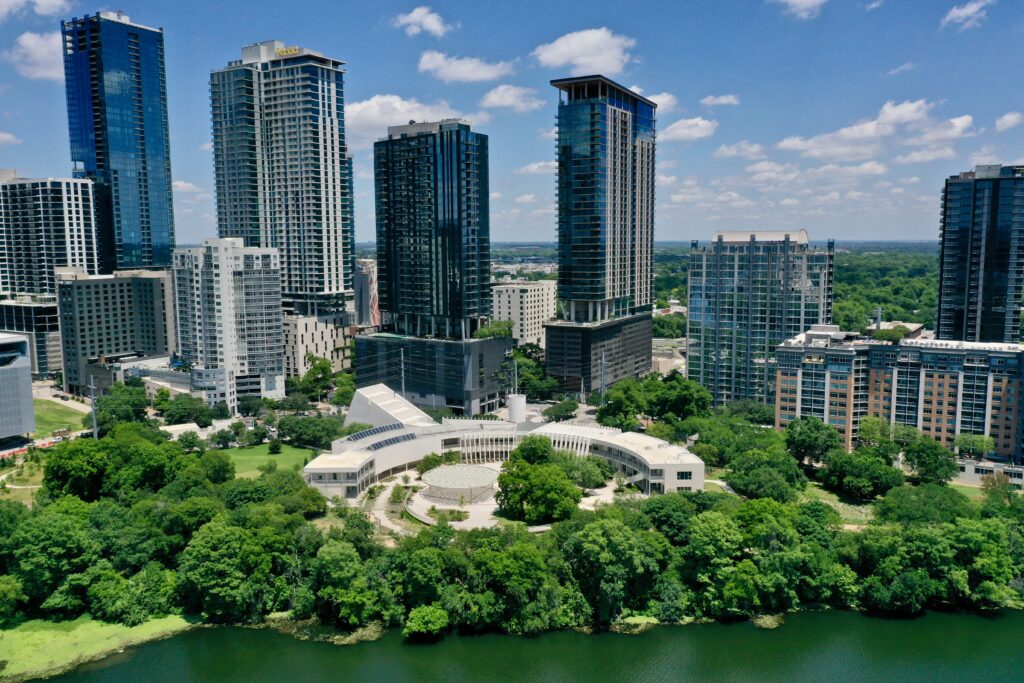
After $25 Million in expansions, the Emma S. Barrientos Mexican American Cultural Center is now equipped with a versatile, luminous children’s education wing, sparkling kitchen, and a pristine library and media room. Visual art and dance studios were added or improved, and even office space was expanded, not to mention work on the plaza, or zocalo. A community gallery will showcase up-and-coming artists. Besides richer teaching opportunities and art practice spaces, more non-profits and groups like the Tejano Genealogy Society of Austin may now meet on site, explained Michelle Rojas, Culture and Arts Education Manager at the ESB-MACC.
The building facade is still starkly white, like an ancient temple, but the two-story build is now more convincingly shaped like the moon, an idea the original plan architects had in mind, said Juan Miró of Miró Rivera Architects. The firm was tapped to complete phase two of the center’s plans alongside Tatiana Bilbao ESTUDIO of Mexico. Phase one came from the mind of Mexican architect Teodoro González de León and Austin’s CasaBella + Del Campo & Maru.

Architect’s Moon
The building at 600 River Street had stubby arms when it opened in 2007, as original plans were left half complete. “It looked like a hug with the arms cut off at the shoulder,” said Miró. Teodoro envisioned the site as a moon facing the sun as it set on Lady Bird Lake, though the Colorado is hardly visible through the foliage. If the trees were trimmed, you could actually see the water.
SHOP


Miró and Bilbao carefully considered the expressed needs of the community as they fulfilled the vision laid out in phase one plans, extending the arms of the moon. A missing view of the lake is only one of a handful of compromises made, but who can say what may come in an eventual phase 3. There are plans, but many features in the original plans are not allowed by the city, explained Miró, like ramps to the water and boat docks.
Considering the inflation of project costs from 2018, when the General Obligation Bond passed granting funds to use for the center’s second phase, the value may still be seen as fairly high. The Perez-Ramos Plaza between the center and the hike and bike trail, for example, is now defined by a metal shade structure 80 feet in diameter. Live performances will find relief from the heat beneath its roof, made to evoke papel picado, the Mexican folk art tradition of cutting delicate designs into colorful banners. Ten Eyck Landscape Architects planted native and adapted species throughout and around the grounds. Gardens now include raised beds where corn, squash, and beans have begun to be planted. Benito Huerta’s “Snake Path,” a brick design of the non-poisonous milk snake leading from the parking lot to the plaza now culminates in an elevated overlook. Railings and fences define the property, so trail runners and other pedestrians will ideally notice the ESB-MACC as a discrete place versus stumbling onto it. The children’s education wing features fenced outdoor play areas, neutralizing any threat of stray dogs or strangers, and the kitchen features a camera over an instructor station for culinary workshops. Energy use is also efficient, with amply daylit rooms and connection to the city chillers.
To harmonize with the hand-chiseled concrete panels imported from Mexico for the phase one facade, white brick was selected for phase two. Individually stacked at angles, they create shadows that echo the overall pyramidal inspiration of the center and the crafted feel of the glinting, quartz-heavy concrete.
The selection of architecture studios from either side of the border echoes the experience of the Mexican American, opined architect David Goujon. Mexican-born and Texas-raised, Goujon became active in the community after a local piñata store called jumpolin was demolished in 2015. As a protest, he constructed three 10-foot-tall piñata installations, leading him to a place of connection with Austin’s Hispanic community. Eventually, he joined the MACC board. The story of the center, he said, is really the story of the people who fought for it.

Strength and Beauty
The best part of the arts space may indeed be the connection it shares with the Chicano community and activism of decades past. The lineage of spaces like El Centro Chicano and Juárez-Lincoln University continues with the Emma S. Barrientos Mexican American Cultural Center, despite the center’s seemingly polite focus on the visual and expressive arts. Art was long a part of activism in the Chicano civil rights movement, and local students advocated for the spaces to create for many reasons. Muralism is a respected visual form admired by Mexican-Americans who look back to Mexico’s big three muralists, Diego Rivera, David Alfaro Siqueiros, and José Clemente Orozco, for inspiration. It is not, of course, the only form meaningful to advocates in Austin.
Olga Campos-Benz remembers the frigid Public Works facilities warehouse formerly located where the ESB-MACC is today. She and her daughters shivered while watching Los Pastoreles, a play staged by Chicano activists, her daughters saying “Mom, it’s so cold.” Today, the complex features a theater set in a pyramid inspired by the architecture of Mexico. Which is to say that the ESB-MACC has come a long way, though the path continues.
In the building, a community may nurture at least some of its youth through programs like the Academia Cuauhtli bilingual summer camps fusing technology and cultural arts, Caminos teen leadership programs, Sábados en Familia arts and crafts family programs, and bilingual summer camps. For adults, Casa de la Cultura will offer classes in eight areas including cooking, dance, gardening, music, movement, film, literature, and art.
The mission, officially, is “to preserve, create, promote and present the Mexican American Cultural Arts and Heritage along with other Latino Cultures.” Annual events like the ¡Viva México!, Día de los Muertos, and La Mujer festivals welcome all.
“My hope is that it is seen as a space that is necessary in Austin and welcoming to everybody,” said architect Goujon.
The Mexican American Cultural Center’s grand reopening celebration is planned for June 6. They include live music, dance performances and food trucks. Learn more about the reopening and upcoming events at www.austintexas.gov/macc.
RELATED: Waterloo Greenway to Open $91.5 Million Confluence Project in Downtown Austin