
Waterloo Greenway to Open $91.5 Million Confluence Project in Downtown Austin
The second phase of the Waterloo Greenway will add 13 acres of trails, bridges, native plantings and restored Waller Creek habitat
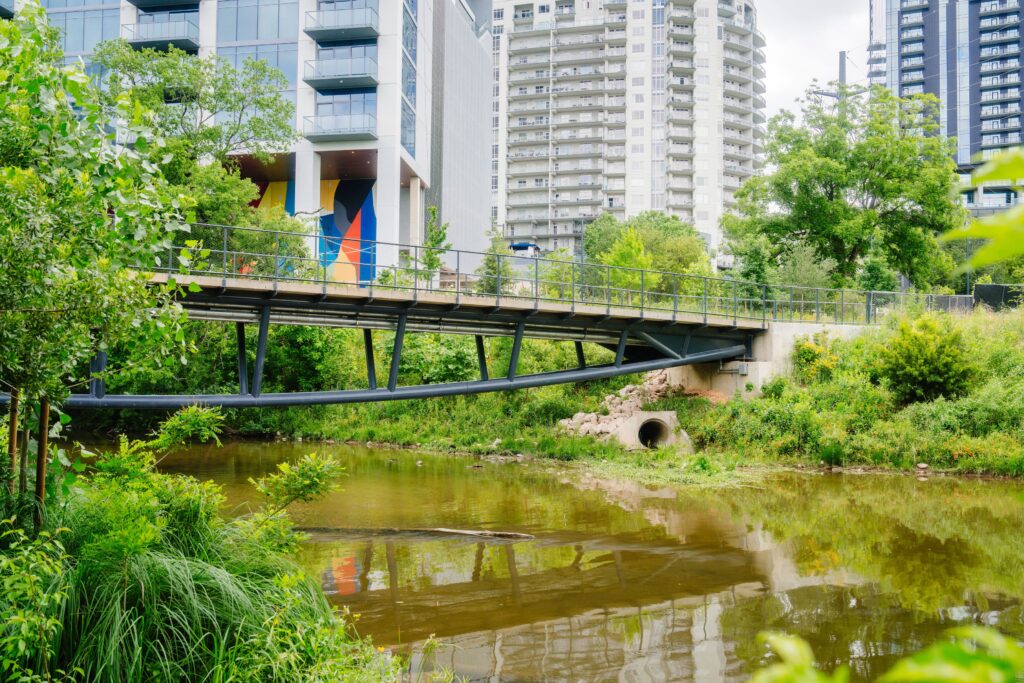
Austin’s effort to create a more connected downtown will take a major step forward on June 6 with the opening of The Confluence. Spanning 13 acres between 4th Street and Lady Bird Lake, the project transforms a once-overlooked creek corridor into a connected green space designed for walking, biking and gathering. The project introduces an 800-foot boardwalk embedded directly into Waller Creek, three pedestrian bridges and thousands of native plantings intended to reshape how people move through the city.
The project reflects years of environmental restoration and community planning.
“There’s a quote by Margaret Mead that says: ‘Never doubt that a small group of thoughtful, committed citizens can change the world; indeed, it’s the only thing that ever has’,” says Dr. Colette Pierce Burnette, CEO of Waterloo Greenway Conservancy. “And this project is really an example of that.”

A community-driven vision
The idea for Waterloo Greenway began more than a decade ago through an international design competition in 2012. According to John Rigdon, chief planning and design officer at Waterloo Greenway Conservancy, community feedback has shaped the project from the beginning through public meetings, programming and conversations during events.
The first phase of the project, which introduced Waterloo Park and Moody Amphitheater, opened in 2021, and construction on The Confluence began in May 2023.
“Community input is really core to this whole project,” Rigdon says. “We have this long trajectory of community conversations that have shaped the project.”
Rather than relying solely on formal meetings or surveys, Rigdon says the team often gathered feedback organically through park programming and public events.
“Some of the very exciting conversations we have that shape the design are when we interact with the community during a kids’ activity or a senior fitness class,” Rigdon says. “People bring up ideas, concerns or questions, and those conversations are really fruitful points of engagement.”

Designed around connection
While Waterloo Park centered heavily on programming and gathering spaces, The Confluence places a stronger emphasis on ecology, restoration and mobility.
Building on the protection provided by the Waller Creek Flood Control Tunnel, the project reconstructs and stabilizes the eroded banks of Waller Creek while restoring the surrounding ecology.
Rigdon says decades of flooding and erosion damaged the creek’s banks, surrounding habitat and water quality in the lower section of the watershed.
“All of those issues were major challenges as we approached the restoration and reconstruction of the creek,” he says.
Designed by Michael Van Valkenburgh Associates and built by Jay-Reese Contractors Inc., The Confluence introduces an 800-foot boardwalk embedded directly into Waller Creek, along with three lattice pedestrian bridges that allow visitors to move through downtown without crossing busy intersections. The entire trail system is fully ADA-accessible.
The project also includes nearly 1,600 new trees, 200,000 native plants and 10 acres of seed mixes designed to improve air quality, reduce greenhouse gas emissions and support native wildlife.
“The detail that went into our approach to planting is extensive,” Rigdon says. “That investment in trees alone is over $5 million. It’s a massive investment in Austin’s urban tree canopy.”
Part of the densely planted landscape was intentionally designed as a “successional tree canopy,” balancing fast-growing shade trees with slower-growing species intended to shape the space for generations to come.
“Some of the trees will grow very fast and provide shade day one, year 10, year 15,” Rigdon says. “But trees can have disease, things can happen, so we also planted slower-growing trees that will be our year 200 shade canopy.”
The Conservancy also opted to manage the landscape without pesticides, relying instead on hand maintenance and adaptive ecological management practices.

Reimagining downtown Austin
For the Waterloo Greenway Conservancy team, the project is ultimately about bringing people closer — to nature, to downtown Austin and to one another.
“We transformed Waller Creek from a forgotten space into a destination for everyone,” Burnette says. “When people are at The Confluence, I want it to be a destination and an experience that they’re looking forward to the next time.”
According to Burnette, the project reflects a broader shift in how Austin thinks about urban infrastructure as downtown continues to grow upward with new high-rises in a city that recently surpassed one million residents.
“As the city gets vertical with all these tall buildings, we also want to make sure that we advance the quality of life for Austinites, which includes green spaces,” she says. “I’m very proud to be a part of a community that embraces that need as a part of the basic infrastructure of what makes a city livable.”
Beyond environmental restoration, The Confluence introduces new gathering spaces throughout downtown, including Lakeview Terrace, Explorers Garden and an outdoor classroom terrace designed for community programming and family activities. Waterloo Greenway Conservancy also plans to bring live music, art activations and educational events into the space over time.
“We had some really critical, non-negotiable priorities that we had to achieve with this project and with the Greenway as a whole,” Rigdon says. “Those include creating a universally accessible trail network throughout, improving safety, restoring the health of the creek — both the health of the water and the health of the surrounding habitat — stabilizing and restoring the banks of the creek, and again, creating spaces to invite the community.”
Rigdon hopes visitors leave with a different perception of downtown Austin altogether, realizing they can spend an entire day downtown safely, accessibly and immersed in nature without constantly needing to get back into a car.
“I hope people join us for the first time and are shocked by how connected they feel — to the landscape, to each other, but also to the surrounding areas they previously thought were too far apart,” Rigdon says.

How to attend the opening
The opening celebration for The Confluence will take place June 6 from 10 a.m. to 2 p.m. Admission is free and open to the public, with programming including a ribbon-cutting ceremony, park tours, live music and family-friendly activities. More information can be found at Waterloo Greenway’s website.
Looking ahead, Waterloo Greenway will next focus on Palm Park, with construction anticipated to begin in 2027, and Phase III, which will complete the restoration of Waller Creek from 4th Street to 12th Street. Once finished, the 1.5-mile trail system will create a continuous north-south green corridor connecting Lady Bird Lake to East 15th Street, totaling 35 acres of connected green space through the heart of downtown Austin.
“To say that our community built this together in partnership with the city,” Burnette says, “I think that’s an accomplishment.”
RELATED: Austin’s Unity Tunnel Transforms a Lady Bird Lake Underpass Into a Community Mosaic