
What Italy’s Mille Miglia Car Race Taught Kristin Armstrong About Lasting Love
The longtime TRIBEZA contributor, author and counselor shares lessons from taking on the 1,000-mile vintage car race with her husband

In an ideal love story, when you find your person and fall in love, your heart and your world expand. This is true for my love story. I considered myself to have a full and epic life before I met my husband, Mark. Little did I know how much that story would deepen and expand. We have added collective children for a nest of five, both of our careers have accelerated, and we continue to learn new things individually and together.
I constantly tell my children and single clients, “Make sure the person you marry is someone you want to have dinner with for the rest of your life.” Not just because they are someone you don’t mind looking at across the table, but because you’re both equally committed to being curious and vibrant people, always learning new things that make for interesting dinner conversation. My mother always told me, “If you are bored, you are boring.” I hated this statement as a child, but I see its powerful wisdom today.
That said, it does help if your person is actually interesting.
Mark has always had an interest in vintage cars since he was a little boy tinkering with Model T’s in the garage with his father. Now he collects, shows, races and does rallies with vintage cars. It was one of Mark’s dreams to do the Mille Miglia, a 1,000-mile car race on open roads throughout Italy. There are about 500 cars in this race, and all must meet a long list of qualifications to enter. We did this race once when we were dating, once when we were engaged and twice now as a married team.
Most teams are composed of two males, often car buddies with a similar bucket list. There are few women teams in the mix, fewer still married couples — likely because tensions can run high when you spend over 14 hours a day for five days in a small vintage racecar, usually with an open top in scorching Italian heat. There are all kinds of interesting things that happen with old cars, and there are always challenges — flat tires, missed turns, overheating engines, collisions in crowded cities, language barriers and running out of gas (or putting in diesel by mistake). We have endured all of the above and more.
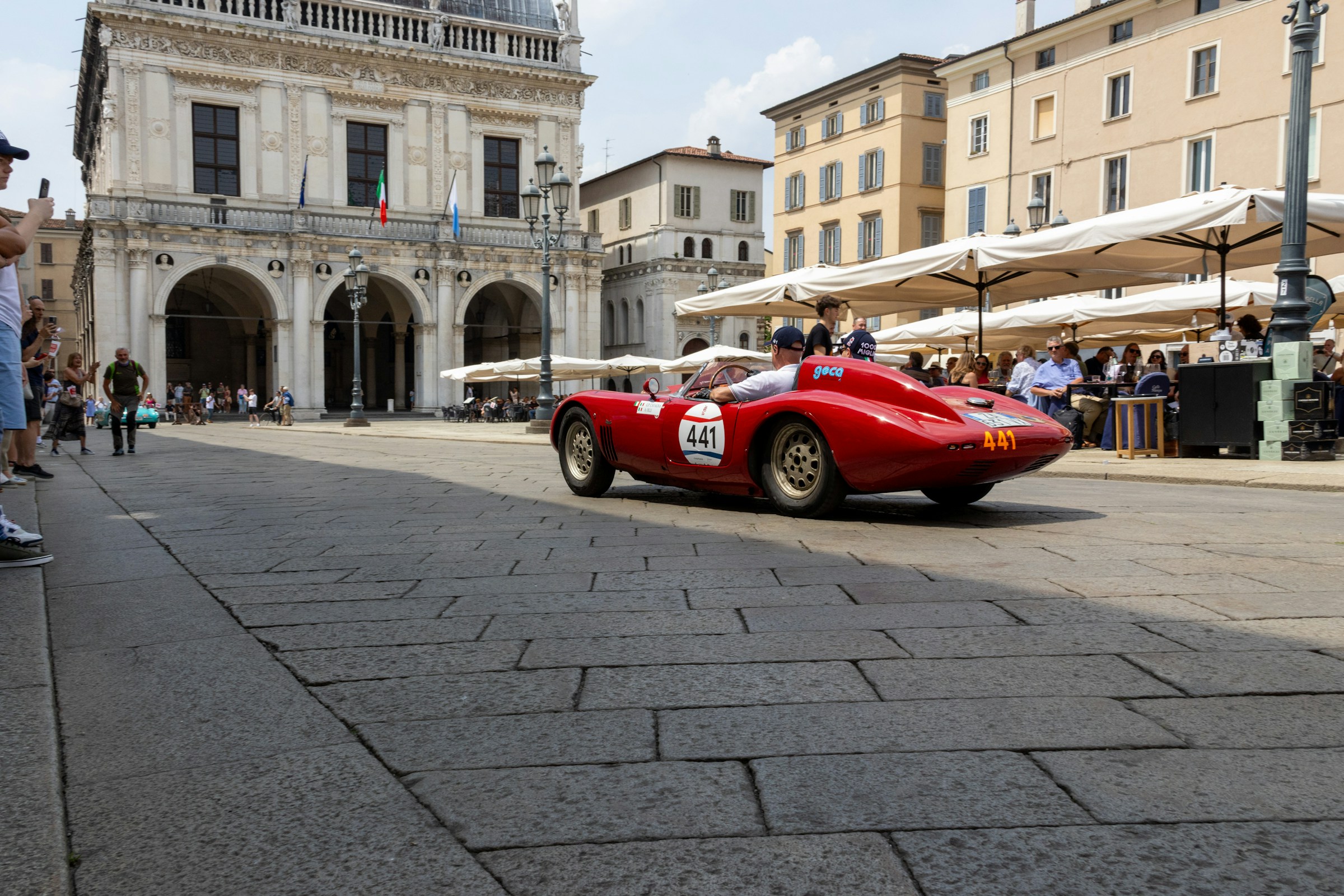
Lessons from the road
Mark is the driver (piloto), and I am the navigator (navigatore). This means that I am in charge of the roadbook, which is a spiral-bound guide — one hefty tome for each day of the race. Each page has boxes with hieroglyphic route drawings and instructions in Italian, with the corresponding kilometers. We wear headsets because the wind from the open top and the engine noise are loud.
For hours, I say things like, “In 200 meters, you will make a hard right. At the next roundabout in three kilometers, take the third exit, 9:00, direction Rimini.” We spend hours like this, side by side, racing through a backdrop of vineyards, lakes, seaside towns, ancient walled villages and chaotic major Italian cities. It’s exhausting and utterly extraordinary. The only thing more beautiful than the landscape and the people of Italy is the beauty and depth this event brings to our marriage.
We race with an incredible team called Scuderia Sports, which includes the finest friends, mechanics and organizers — brilliant and beloved people who work so hard to make sure we are safe, successful and having fun.
There is a celebratory team dinner after the race finishes. Laughter, words and tears flow as we raise toasts, give thanks and recount our adventures. Each team gets a chance to say a few words.
After my elegant husband spoke, the mic was mine. There were a thousand things I could say, and a thousand more words of gratitude to offer for a safe and joyful finish. But one idea had been bubbling up in my heart and mind for days: authenticity.
One of the qualifications to enter the Mille Miglia is that your car must be authentic. The make and model, or perhaps even the car itself, must have participated in a Mille race between 1927 and 1957. The car is authenticated through official records and paperwork and a thorough examination, a painstaking process called scrutineering. The vehicle identification numbers on the original paperwork and on copious entry forms must match those stamped on the engine and chassis to ensure your car is period correct and original. No fakes. No adaptations. No nonsense.
It occurred to me at some point during the race how special it really is to be “numbers matching,” as the expression goes in car parlance. How incredibly rare and beautiful it is to be authentic, classic and true. When the beauty and attention to detail you see on the outside reflect the craftsmanship on the inside.
When I raised my glass and spoke from my heart that night, it was in honor of my beautiful, authentic and interesting husband, and the authentic version of myself I want to inhabit fully, and the life I want to live.
RELATED: Kristin Armstrong Shares What Each Season of Life Can Teach Us